
How much does a trip to Vietnam cost?
Daily planning bands, a two-week worksheet and the costs travellers forget—from baggage and transfer rides to bank fees and holiday surcharges.
11 minute read · Updated
How this guide is researched and reviewed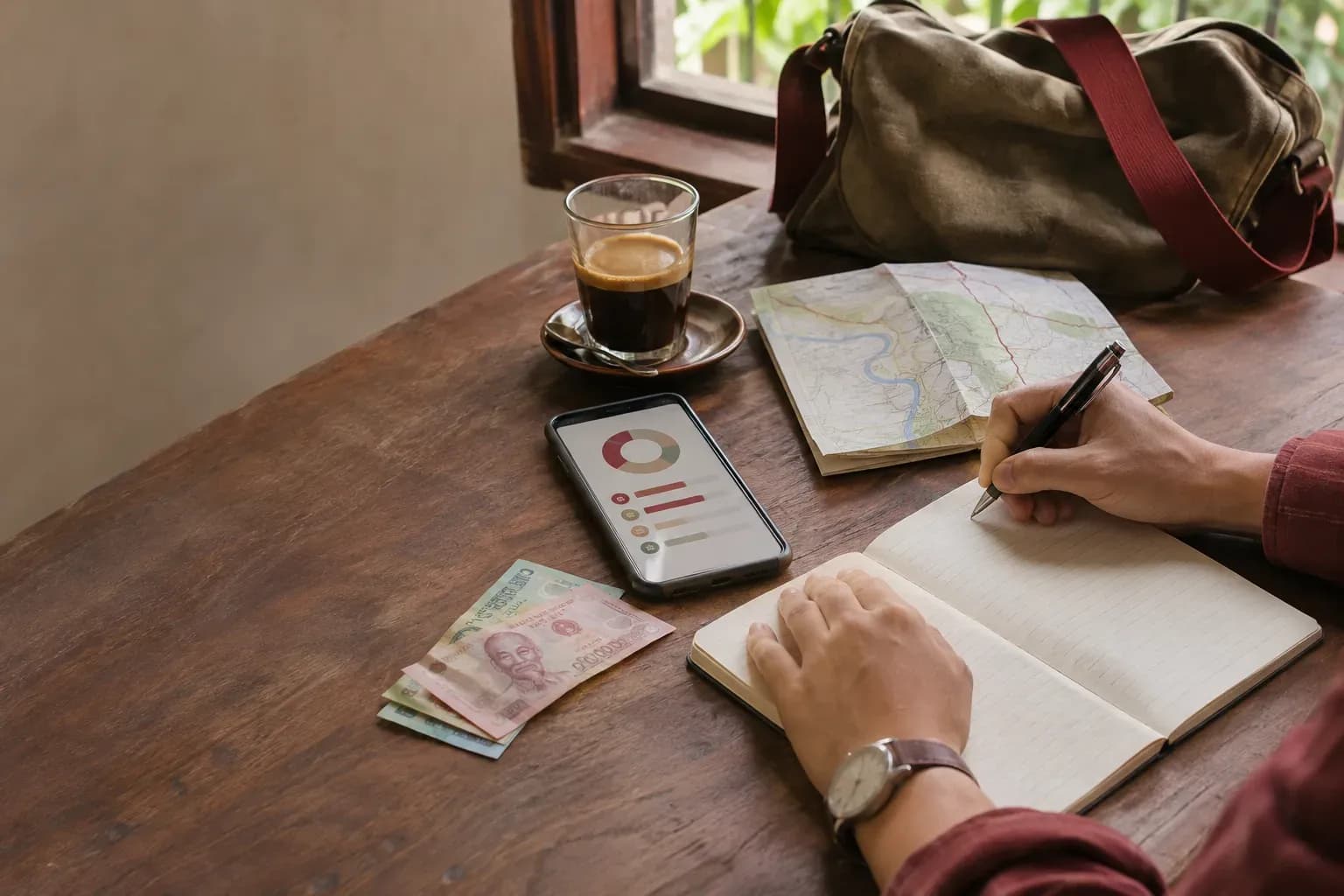
Keep the budget in VND and convert only when reviewing the total.
Hold 15–20% outside the planned spend for changes and recovery days.
Route shape and long transfers usually matter more than small daily purchases.
Daily bands assume two people share a room; solo private rooms cost more per person.
Quick answer
Plan around 900,000–1,500,000 VND per person per day for a careful budget trip, 1,800,000–3,500,000 VND for comfortable mid-range travel, or 4,000,000–7,000,000 VND for comfort-first travel. Price long transfers and premium activities separately, assume rooms are shared by two people, exclude international flights, and keep a 15–20% contingency.
Daily planning bands per person
Use these as route-planning envelopes in VND. International flights and premium private products are excluded; accommodation assumes a shared room.
| Travel style | Daily band | Usually includes | Watch for |
|---|---|---|---|
| Careful budget | 900,000–1,500,000 VND | Simple lodging, local meals, local transport, short regional transfers | Private rooms, route-defining transfers, solo supplements |
| Comfortable mid-range | 1,800,000–3,500,000 VND | Shared private room, mixed dining, app rides, ordinary activities | Holiday pricing, private day tours, extra baggage |
| Comfort first | 4,000,000–7,000,000 VND | Higher-end hotels, private transfers, frequent guided experiences | Resorts, cruises and premium touring can exceed the band |
Recheck current prices for your travel dates. Published examples are reference points, not guaranteed quotes.
In this guide
The short answer: choose a daily band, then add the long transfers
For most independent trips, a useful starting point is 900,000–1,500,000 VND per person per day for a careful budget trip, 1,800,000–3,500,000 VND for a comfortable mid-range trip, and 4,000,000–7,000,000 VND for a comfort-first trip. These are dated editorial planning bands, reviewed in November 2026 from the component prices below—not quoted package prices.
The bands cover accommodation, meals, local transport, ordinary admission and short regional hops. Add every route-defining intercity leg—such as a sleeper train, domestic flight, cruise or private transfer—as a separate line item. Accommodation assumes two people share a room; international flights are excluded.
Use one of two methods and do not mix them. For a fast estimate, multiply the full daily band—including its lodging share—by the trip length, then add route-defining transfers and premium products. For a bottom-up worksheet, replace the band's lodging share with live room quotes and budget only the remaining meals, local transport, admission and margin. Never add actual accommodation on top of a full daily band that already includes lodging.
The most common budgeting mistake is being precise about coffee and vague about transfers. A single late domestic flight, checked bag or private airport pickup can outweigh several days of small savings.
Build the budget in Vietnamese đồng
Vietnam's official currency is the Vietnamese đồng (VND). Keep the working budget in VND even if your bank account is in dollars, euros, won or another currency. Exchange rates move, card issuers add their own margins, and repeated mental conversion makes it easy to undercount small purchases.
Record accommodation per room, then divide it only if the cost is genuinely shared.
Record transport per person, including baggage, seat selection and the ride to and from each station or airport.
Keep a separate cash allowance for markets, street food, small cafés, tips and places that do not accept cards.
Check the live rate shortly before departure and again before a large card payment; do not rely on an old screenshot.
Cards cover many hotels, larger restaurants and online bookings, but cash remains useful for smaller vendors. Carry enough for the day rather than the whole trip, keep a second card separately, and decline unfamiliar conversion offers that charge in your home currency without showing the effective rate.
Three realistic travel styles
Careful budget: 900,000–1,500,000 VND per person per day
This band fits hostel beds or simple shared rooms, local meals, local transport and short regional transfers, self-guided sightseeing and limited nightlife. It works best when the route has fewer bases and no last-minute domestic flight. A solo traveller using private rooms will usually sit near or above the top of the band.
Comfortable mid-range: 1,800,000–3,500,000 VND per person per day
This allows a well-reviewed private room shared by two people, a mix of local restaurants and cafés, app-based rides when they save time, paid attractions, laundry and occasional guided activities. It is the safest planning band for a first independent trip because it leaves room to choose convenience on transfer days.
Comfort first: 4,000,000–7,000,000 VND per person per day
This range supports higher-end hotels, more private local rides or short transfers, destination restaurants and frequent guided experiences. It is not a ceiling: resorts, premium cruises and private multi-day touring can exceed it quickly. Price those products individually rather than treating them as part of a daily average.
How the planning bands were built
The November 2026 planning basket assigns each traveller a share of the room, meals and drinks, local or short regional transport, and ordinary admission or day-to-day margin. It uses broad ranges because season, city and booking terms matter more than a false single average.
Careful budget: 200,000–450,000 VND lodging share, 300,000–500,000 VND food and drink, 150,000–300,000 VND local or short regional transport, and 250,000 VND for ordinary admission and daily margin.
Comfortable mid-range: 500,000–1,000,000 VND lodging share, 500,000–900,000 VND food and drink, 250,000–500,000 VND local transport, and 550,000–1,100,000 VND for admission, activities and daily margin.
Comfort first: 1,500,000–3,000,000 VND lodging share, 900,000–1,500,000 VND food and drink, 600,000–1,200,000 VND local or private transport, and 1,000,000–1,300,000 VND for guided activities and daily margin.
Rebuild the basket with live room and transport quotes for your dates. The figures are reviewed on the same schedule as the underlying price sources and should not be treated as a guarantee.
Where the money actually goes
Accommodation
Accommodation is the largest flexible category. Vietnam Tourism publishes reference prices around 300,000 VND for a budget hostel and 700,000 VND for a mid-range hotel, while noting that location, season and provider change the actual price. In central Hà Nội, Hội An and Ho Chi Minh City, the same room type may cost more on weekends or holidays. Compare the final price after taxes, breakfast and cancellation terms—not the first number in the search result.
Food and drink
A local meal can be inexpensive, but a food budget should include more than three headline meals. Coffee, bottled water, snacks during transfers and an occasional air-conditioned café add up. Vietnam Tourism's current examples include roughly 45,000 VND for a street-food meal with iced tea and about 450,000 VND for a three-course restaurant meal per person. Treat those as reference points, not promises for every city.
Intercity transport
Buses and trains can keep a long route affordable, but the cheapest ticket is not always the cheapest journey. Add the ride to the station, a meal during the transfer, and the value of arriving at an awkward hour. Domestic flights save time on long north–south legs, but the final cost depends on fare class, baggage and change conditions.
Local transport and activities
Walking and public transport reduce costs in the larger cities, while ride-hailing is often worth using when heat, luggage or distance would consume half a day. Boat routes, heritage sites and guided day trips should be listed separately. If an activity is the reason for visiting a place, protect its budget before trimming small daily expenses.
A two-week planning example
For thirteen nights and fourteen days, choose either the full-band shortcut or a bottom-up worksheet. The steps below use the bottom-up method: actual shared-room quotes replace the lodging component of the band, while each person receives a separate allowance only for food, local transport, ordinary admission and day-to-day margin.
Multiply the expected room price by thirteen nights; keep this as a per-room total and use it instead of—not in addition to—the band's lodging share.
Price each long transfer using the actual route and baggage you expect to carry.
Multiply the chosen daily allowance for meals, local rides and ordinary attractions by fourteen and by the number of travellers.
Add fixed experiences such as a guided food walk, boat route or private excursion.
Add a 15–20% contingency that is not pre-assigned to shopping.
Before route-defining transfers, the fourteen-day baseline is 12.6–21.0 million VND per person for a careful budget, 25.2–49.0 million VND for mid-range travel, or 56–98 million VND for comfort-first travel. Those totals still assume two people share a room and exclude international flights.
As a full-band example, two travellers using the midpoint of the mid-range band would reserve about 74.2 million VND for fourteen days of rooms, meals, local transport and ordinary activities. They would then add live quotes for every long rail or air leg, any premium experience, entry costs where applicable, insurance and the contingency. This keeps the estimate auditable instead of hiding the largest decisions inside one average.
A contingency is not an invitation to spend more. It protects the route when weather changes a plan, a convenient train is unavailable, a bank fee appears, or someone needs a quiet recovery day. If it remains unused, it returns home with you.
Pre-trip costs outside the daily band
Keep passport-dependent visa or entry costs, travel insurance, vaccinations or medication and an emergency health buffer outside the daily band. Entry rules and fees can change, so verify them through the official Vietnam Immigration Department e-visa system or the relevant Vietnamese embassy before paying. Insurance terms and health advice depend on the traveller and country of residence; use the insurer's policy wording and qualified medical guidance rather than a generic web estimate.
Costs travellers commonly forget
Airport and station transfers at both ends of a ticket.
Checked baggage, seat selection and fare-change fees on domestic flights.
Early check-in, late checkout or an extra night caused by arrival timing.
Laundry, sunscreen, insect repellent, mobile data and small pharmacy purchases.
ATM operator fees, card foreign-transaction fees and exchange-rate margins.
Holiday supplements and fewer available rooms around Tết and major local holidays.
Single supplements when a quoted tour or room rate assumes two people.
Vietnam Airlines, for example, publishes different baggage and change conditions by domestic fare type. Other airlines use their own rules. Read the fare conditions attached to the exact ticket rather than assuming every economy fare includes the same baggage.
How route shape changes the total
Changing hotels every night creates more paid transfers, more chances to use taxis with luggage and less time to choose meals calmly. A route with four bases across two weeks is usually easier to control than a route with seven. The biggest savings often come from removing one weak stop, not choosing a cheaper coffee.
North–south trips need at least one significant long-distance decision. Compare an overnight train with a flight using door-to-door time and total cost. A night train may replace one hotel night but still require a daytime room or early check-in after arrival. A flight may be short in the air but require two airport transfers and baggage fees.
Where to save and where not to
Good places to save
Stay two or three nights per base and use accommodation within walking distance of the main evening area.
Eat local food for ordinary meals and reserve destination restaurants deliberately.
Book long transfers early enough to keep useful departure times available.
Use laundry services instead of paying airline baggage fees for a larger wardrobe.
False economies
An extremely early flight that requires a private 4 a.m. transfer.
A remote hotel that creates two paid rides every day.
A non-refundable booking made before the route is stable.
A packed itinerary that needs private transport to remain possible.
What to book before arrival
Book the first accommodation, the final accommodation and any route-defining domestic flight or sleeper train once the itinerary is stable. Keep ordinary meals and most local rides flexible. For popular holiday dates, book earlier and confirm opening schedules directly because availability can change faster than editorial guidance.
Save a copy of every confirmation with the final payable amount and cancellation deadline. A useful budget includes what you are committed to paying, not only what has already left the bank account.
A simple budget workflow
Choose the route and number of nights in each base.
Set a room band and check three real properties in each base.
Price the long transfers with baggage and station or airport rides included.
Choose a daily spending band in VND for food, local transport and ordinary admission.
Add fixed activities and a 15–20% contingency.
Review the budget after every route change; do not wait until all bookings are made.
This approach gives you a number that can survive real travel. It also shows exactly what to change when the total is too high: fewer bases, a different transfer, a simpler room category or one less premium activity.
Before you commit to the budget
- 01Choose the route and the number of nights in each base.
- 02Check three realistic rooms in every base using the final payable price.
- 03Price long transfers with baggage and both endpoint rides included.
- 04Separate per-room costs from per-person costs.
- 05Set a VND allowance for meals, local rides and ordinary admission.
- 06Add fixed experiences and a 15–20% contingency.
- 07Record cancellation deadlines and unpaid balances.
Vietnam travel cost questions
Sources and review dates
Time-sensitive claims are checked against the linked source and receive a new review date before they remain public.
- Currency and payments in VietnamChecked
Vietnam Tourism · Supports the official currency, payment guidance and reference prices for food, drink and accommodation.
Review by - Transport within VietnamChecked
Vietnam Tourism · Supports the comparison of rail, bus and motorbike transport and the need to book around holidays.
Review by - Vietnam domestic economy fare conditionsChecked
Vietnam Airlines · Supports the warning that domestic fare classes have different baggage, change and refund conditions.
Review by - Vietnam National Electronic Visa systemChecked
Vietnam Immigration Department · Provides the official application channel supporting the warning to verify passport-dependent entry requirements and fees before paying.
Review by
Read next
Continue with the decisions that most often follow this guide.
First trip to Vietnam: the decisions to make before you book
A complete first-time planning framework for entry requirements, weather, route length, money, connectivity, transport, packing and the first 24 hours.
Vietnam in 14 days: a balanced north-to-south itinerary
A practical first-trip route through Hà Nội, Ninh Bình, Huế, Hội An and Ho Chi Minh City, with protected transfer days and clear options for adding or removing nights.